In Hungary, gas
storage facilities are porous geological structures. In most cases, the rock is
sandstone (Hajdúszoboszló, Pusztaederics, Kardoskút), with one exception
(Zsana), where it is limestone. These
geological formations – where natural gas production has been partially or
fully completed, and which have been reliably proven to be suitable for natural
gas storage – have been converted into underground gas storage facilities. The
conversion involved:
- the conversion of wells originally
used for gas production and, where necessary, the drilling of new ones;
- the construction of a natural gas
gathering and distribution system;
- the installation of related injection
and gas processing equipment;
- and the construction of relevant
transmission pipeline connections.
The first
facility in Hungary for underground gas storage was built near Őrszentmiklós to
store natural gas produced in this region. From 1960, natural gas stored here
also helped meet the peak demand of Budapest during the winter period. However,
the continuous increase in the demand for natural gas made it necessary to
establish additional underground storage facilities. The programme started in
1978 with the conversion of the depleted working natural gas field in the area
of Kardoskút, and was continued the following year by commissioning two
additional facilities in Hajdúszoboszló and Pusztaederics. Currently, we
operate four underground gas storage facilities: Pusztaederics, Kardoskút,
Hajdúszoboszló and Zsana.
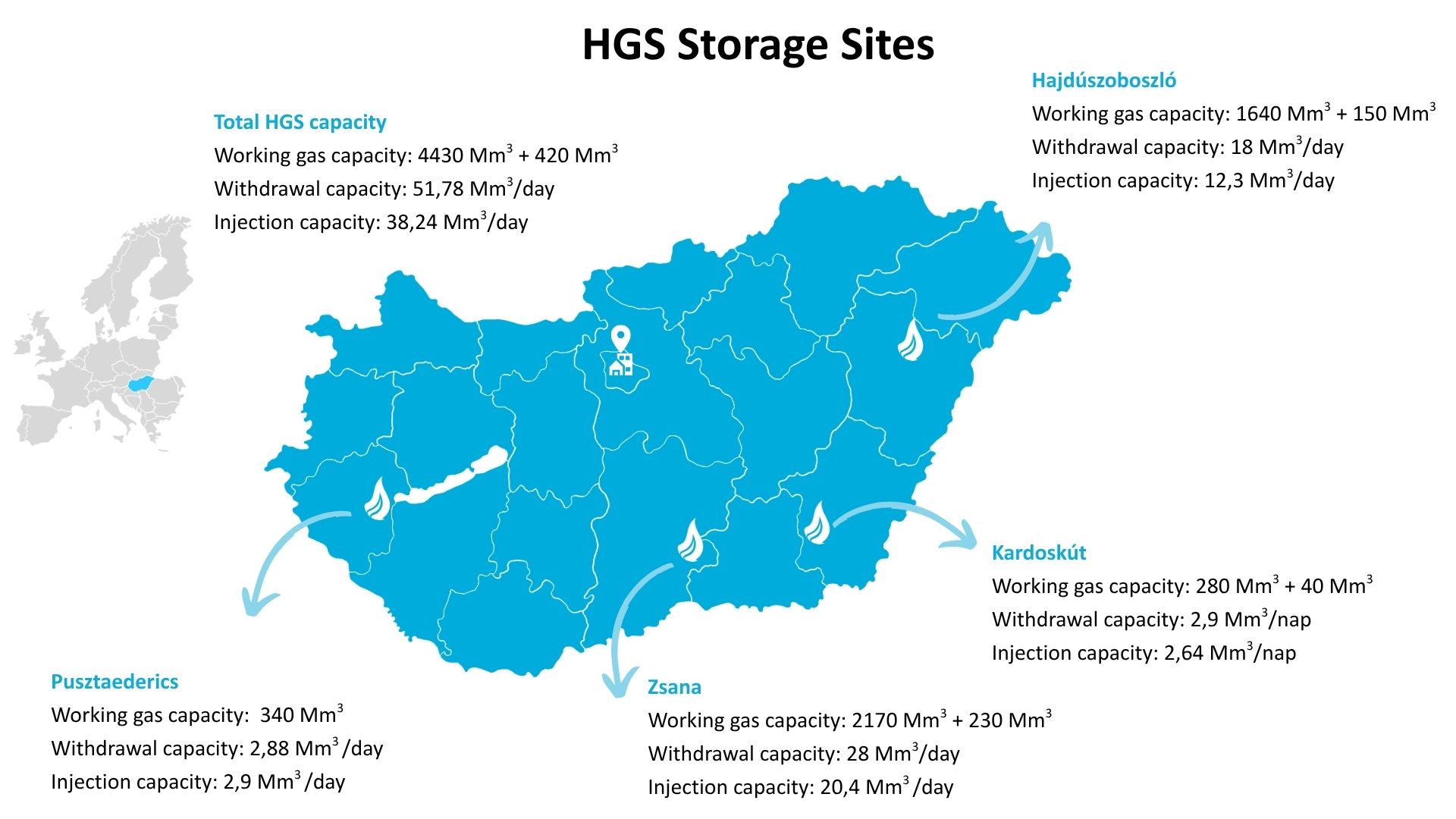
Capacities
Hungarian Gas
Storage Ltd. operates four underground gas storage facilities in Hungary, with
a total storage capacity of 4.43 billion m3 of working gas plus 420 Mm3 of
additional capacity.
Storage
cycles:
Start of
injection period: 1 April
End of injection
period: 30 September
Start of
withdrawal period: 1 October
End of withdrawal
period: 31 March
Natural Gas
Storage Sites
Hungarian Natural
Gas Storage Ltd. has four underground gas storage sites, where it stores
natural gas in partially depleted natural gas fields (in gas-bearing geological
formations and gas reservoirs).
Only those
gas-bearing reservoirs can be considered for natural gas storage
- whose impermeability has been proven
for subsequent storage operations,
- where the storage rock itself has the
necessary storage properties and is also sufficiently stable,
- where natural gas can be injected and
stored relatively easily, and can be fully withdrawn from the storage
layer cost-effectively.
Only a fraction
of the hundreds of depleted fields meet these requirements. Naturally, in
addition to technical considerations, economic calculations also play a role in
selecting a storage site. A fundamental requirement, for example, is that
natural gas must be injectable at a relatively low pressure of 60–80 bar, with
a maximum of 210 bar. This is possible if the reservoir is located at a depth
not exceeding 2000–2500 metres, and its reservoir rock has high permeability.
Zsana
Withdrawal
capacity: 28 Mm3/day
Injection
capacity: 20.4 Mm3/day
Working gas
capacity: 2,170 Mm3 + 230 Mm3
Exploration for
hydrocarbons began in the vicinity of the village of Zsana in 1978.
Over the ten-year
period between 1982 and 1992, approximately 4 billion m3 of gas was produced
from the gas reservoirs in Zsana, and then the construction of the Zsana gas
storage site began in 1992.
The storage
facility’s initial capacity was 600 million cubic metres, and the first
withdrawal took place in November 1996. At that time, the facility’s daily
withdrawal capacity was around 8 million cubic metres. Owing to its geological
characteristics (limestone reservoir) the Zsanai storage site is the most
flexible natural gas storage facility in Hungary. Four layers at depths of
1,695–1,780 metres below sea level take part in natural gas storage.
Following a
multi-phase expansion, the storage facility’s capacity grew to 1,570 million m³
by 2008, with a peak withdrawal capacity of 24 million m³/day and a peak
injection capacity of 10.2 million m³/day.
In the summer of
2008, a further expansion of the storage facility began with an investment of
HUF 32 billion. Due to the expansion completed by autumn 2009, the storage
capacity increased by 600 million cubic metres, reaching nearly 2.2 billion
cubic metres, while the daily withdrawal capacity rose to 28 million cubic
metres per day. Injection capacity has also increased significantly with the
new turbo compressors, reaching a rate of 20.4 million m³/day.
Hajdúszoboszló
Withdrawal
capacity: 18 Mm3/day
Injection
capacity: 12.3 Mm3/day
Working gas
capacity: 1,640 Mm3 + 150 Mm3
Hajdúszoboszló
was once Hungary's most important natural gas field. The exploitation of the
deposits discovered during the 1950s marked the beginning of the natural gas
era in Hungary. During the boom period of natural gas production, starting in
the late 1960s, 1.8 billion cubic metres of natural gas were extracted annually
from the Hajdúszoboszló field.
Construction of
the facility began in 1977; by 1981, the storage site's 35 wells, each equipped
with a special sand screen, were capable of receiving 400 million cubic metres
of working gas.
Through further
developments, the storage site's working gas capacity reached 1,640 million
cubic metres. Reconstruction work began in the 1990s to secure the storage
site's existing capacities for the long term.
The storage site,
with a current nominal working gas capacity of 1,640 million cubic metres, has
a daily withdrawal capacity of 18 million m³ and a daily injection capacity of
12.3 million m³.
Pusztaederics
Withdrawal
capacity: 2.88 Mm3/day
Injection
capacity: 2.9 Mm3/day
Working gas
capacity: 340 Mm3
The Pusztaederics
gas storage site is operated in sandstone formed in the Lower Pannonian period
(upper and lower Nova reservoirs, Szolnok Sandstone Formation).
The storage site
was created by repurposing the depleted Hahót-Ederics natural gas field. The
idea of establishing the storage site first emerged in the 1970s.
Between 1972 and
1979, five former natural gas production wells were put into use for gas
storage, making the Pusztaederics facility Hungary’s first natural gas storage
site. By 1979, an additional seven wells had been completed, at which point the
facility was officially qualified as a natural gas storage site. At that time,
there were a total of 12 wells with a working gas capacity of 100 million cubic
metres. In 1988, this capacity was expanded by 100 million cubic metres, and
additional wells were installed during further developments in 1991.
The current
nominal working gas capacity is 340 million cubic metres. The daily withdrawal
capacity is 2.88 million m³, while the daily injection capacity is 2.9 million
m³. A cushion gas volume of 266 million m³ ensures the smooth operation of the
storage facility. A project to extend the service life of the storage facility
was recently completed, designed to ensure its continued smooth operation in
the future.
The Pusztederics
facility is the only natural gas storage facility in Transdanubia, thus playing
an essential role in maintaining the hydraulic balance of the high-pressure
pipeline network in the western part of the country.
Kardoskút
Withdrawal
capacity: 2.9 Mm3/day
Injection
capacity: 2.64 Mm3/day
Working gas
capacity: 280 Mm3 + 40 Mm3
In 1960, a field
containing slightly more than 1 billion cubic metres of extractable natural gas
was discovered in the vicinity of Kardoskút and Pusztaszőlős. Production began
in 1966. Production began in 1966. Once the field was depleted, its use for natural
gas storage began in 1978, starting with only seven wells. Between 1980 and
1984, surface facilities and storage capacity were expanded, which involved the
drilling of numerous new wells.
The average depth
of the sandstone reservoir suitable for natural gas storage is 1,000–1,100 m.
The Kardoskút storage site currently operates with 21 production wells and 8
observation wells. Its current working gas capacity is 280 million cubic
metres, and its withdrawal capacity is 2.9 million cubic metres per day.